what is the order of planets, from closest to the sun to furthest from the sun?
Planets in Order From the Lord's day
Our solar system is located in the Orion screw arm of the Milky Way Milky way and contains 8 official planets that orbit counterclockwise around the Lord's day. The order of the viii official planets from the Sun, starting closest and moving outward:
- Mercury
- Venus
- Globe
- Mars
- Jupiter
- Saturn
- Uranus
- Neptune

Order of planets from the Sun. Universe Today
In addition to the planets, our solar system as well includes dwarf planets, moons, asteroids, comets, and meteoroids.
What is the Definition of a Planet?
At that place is an ongoing debate about the number of planets in our solar system. The most recent definition of a planet was released in 2006 by the International Astronomical Union (IAU), an organization responsible for classifying astronomical objects.
Their definition requires a planet to:
- Orbit around the Lord's day,
- Have enough gravity to force it into a spherical shape,
- Have cleared away any other objects of like size near its orbit around the Dominicus.
The Definition Debate
Astronomers and planetary scientists did not unanimously concord with the new IAU definition and was contested by planetary scientists who prefer the geophysical definition of a planet.
When compared to the IAU planet definition, planetary scientist Alan Stern's 2018 definition excludes the first point (that a planet be in orbit around the dominicus) and third point (that a planet has cleared the neighborhood around its orbit). Stern's definition thus counts dwarf planets and planetary-mass moons as planets.
Many professionals in the field besides criticize the IAU definition of trying to limit the number of planets with the most contempo modify to the definition, as it was ultimately responsible for Pluto beingness removed as the ninth planet and re-labeled a dwarf planet.
The IAU currently recognizes 5 dwarf planets:
- Ceres
- Eris
- Haumea
- Makemake
- Pluto
Based on the geophysical definition of a planet, in that location are several satellite and dwarf planets in the solar system and likely more that oasis't been discovered.
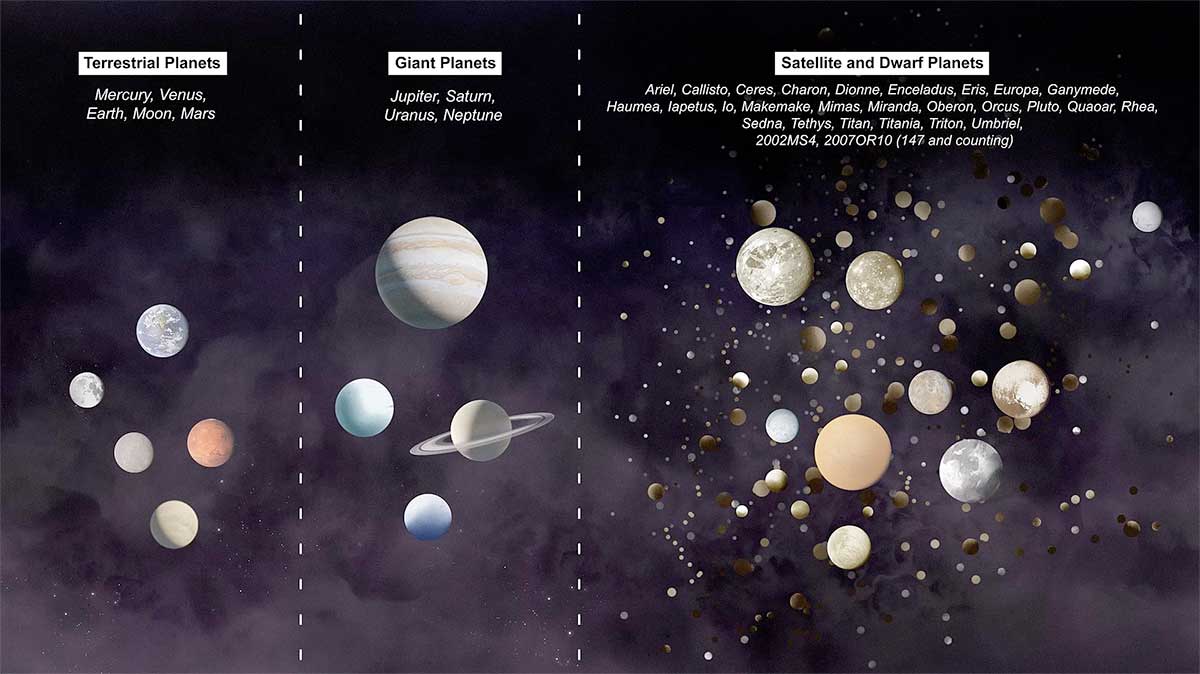
Geophysical classification of planets. Johns Hopkins APL/Mike Yakovlev
Planet Gild from the Lord's day
All planets and dwarf planets recognized by the IAU will be included and separated by three categories of planets; Terrestrial, Behemothic and Dwarf planets.
Terrestrial and Giant Planets in order from the Sunday
Terrestrial Planets
Terrestrial planets include the 4 closest planets to the Dominicus located betwixt the Sun and the asteroid chugalug; Mercury, Venus, Earth and Mars. Astronomers who utilise the geophysical definition of a planet would also include the Moon as a terrestrial planet.
Terrestrial planets are planets with a solid surface, oftentimes fabricated upwardly of rock or metals. These types of planets also accept few moons, a molten core and can have surface features similar valleys, mountains and volcanoes.

The terrestrial planets: Mercury, Venus, Globe and Mars, sized to scale.
Mercury paradigm: NASA/JHUAPL Venus image: NASA/JPL-Caltech Earth image: NASA/Apollo 17 crew Mars image: ESA/MPS/UPD/LAM/IAA/RSSD/INTA/UPM/DASP/IDA
Mercury
Mercury is the closest planet to the Lord's day and is the smallest of the eight planets being merely slightly larger than our moon. Mercury'due south surface temperatures vary in extremes reaching day temperatures as high as 800°F (430°C) and dipping as low as -290°F (-180°C), defective the temper to hold the estrus at dark.
One day lasts a long time on Mercury since the planet spins slowly – it takes 59 Earth days to make ane full rotation. Even so, a yr on Mercury goes fairly fast due to the proximity to the Sun. Information technology takes merely 88 Earth days, making it the fastest planet to orbit the Sun.
2 spacecraft have visited Mercury, including Mariner (1974/75) and Messenger (launched in 2004). Messenger orbited Mercury over 4,000 times in four years then crashed into the planet's surface after running out of fuel. In 2016, scientists released the first digital-meridian model of Mercury, which combined more 10,000 images acquired by Messenger.
- Bore: 3,031 miles or 4,878 km
- Distance from Sun: 0.4 Astronomical Units (AU)
- Solar day: 59 Earth days
- Orbit: 88 World days
- Natural Satellites: None

Mariner 10 image of Mercury. NASA
Above: I prove my married woman Ashley the planet, Mercury, for the first time using binoculars.
Venus
Venus is the second planet from the Sun and is the second-brightest natural object in Globe's night sky after the Moon. It is like to World in size and mass and is known as World'southward sister or twin planet. Venus' rotation catamenia of 243 Earth days is slower than whatsoever other planet and is one of two planets to rotate in the contrary direction (e to west).
Venus' atmospheric conditions are an extreme example of the greenhouse outcome. It's thick, toxic atmosphere traps its heat resulting in temperatures upwardly of 880 degrees Fahrenheit (471 degrees Celsius), making Venus the hottest planet in the solar arrangement.
Due to these atmospheric conditions, detailed explorations of Venus is difficult. It was the first planet visited past a spacecraft (Mariner two) and the first to be successfully landed on (Venera 7) but the first detailed maps were non possible until the arrival of Magellan in 1991.
- Diameter: 7,521 miles or 12,104 km
- Distance from Sun: 0.7 AU
- Day: 241 Earth days
- Orbit: 225 Earth days
- Natural Satellites: None

Image of Venus using data from NASA'southward Magellan spacecraft and Pioneer Venus Orbiter. NASA
Earth
Earth is the third planet from the Sun and it is the 5th-largest planet. Earth's orbit around the Sun is 365.25 days, rotating on a tilted axis which is responsible for the four seasons. Earth's gravity interacts with the Moon, it's only natural satellite, helping to stabilize Earth's axis orientation and slows its rotation causing tides.
Approximately 29% of the Earth'south surface is state (i.eastward. continents and islands) with the remaining 71% covered with water (i.eastward. oceans, lakes, rivers and freshwater). Globe's outer layer consists of several tectonic plates with a solid inner core and liquid outer cadre. Earth'southward temper is rich in nitrogen and oxygen and several other gases in smaller amounts.
Globe'southward distance from the Dominicus, concrete backdrop, and geological history accept allowed life to evolve and exist on Earth. There are several million species of life on our planet with scientists believing there are more species that have even so to be discovered.
- Bore: 7,926 miles (12,760 km)
- Altitude from Dominicus: ane AU
- 24-hour interval: 23 hours, 56 minutes
- Orbit: 365.25 Earth days
- Natural Satellites: the Moon

Image of Globe. NASA
Mars
Mars is the fourth planet from the Sun, known as the Scarlet Planet from iron oxide (rust) in the soil. Mars is home to the highest known mountain and largest canyon and polar ice caps in both hemispheres that remain frozen year-round.
Due to its depression atmospheric force per unit area, liquid water cannot exist on its surface, except at the lowest elevations for curt periods of time. Surface features and data from space missions have led scientists to believe that water might take flowed along the surface of Mars and may still be inside hugger-mugger rock. Scientific bear witness also suggests Mars was once a much warmer planet.
Mars is one of the nigh explored planets in the solar organization including missions to assess the habitability and possibility of life on Mars. The first spacecraft to visit Mars (Mariner 4), captured the first images of another planet from space.
Viking 1 was the starting time spacecraft to successfully land on the surface of Mars, and Sojourner, part of the Mars Pathfinder spacecraft, was the first robotic rover to operate on Mars. Additional astrobiology missions are planned with the Perseverance and Rosalind Franklin rovers.
- Bore: 4,217 miles (6,787 km)
- Distance from Sun: 1.5 AU
- 24-hour interval: 24 hours, 37 minutes
- Orbit: 687 Earth days
- Natural Satellites: Deimos and Phobos

Mosaic of the Valles Marineris hemisphere of Mars. NASA
In a higher place: I photo the planet Mars as it approached opposition in 2020.
Behemothic Planets
Giant planets, besides known as Jovian planets, are massive planets with a thick hydrogen and helium atmosphere, normally made of low-boiling-betoken materials (i.e. gases or ices). This includes Jupiter, Saturn, Uranus and Neptune.
Jupiter and Saturn (the gas giants) are made up of by and large hydrogen and helium, whereas Uranus and Neptune are more often than not composed of h2o, ammonia, and marsh gas and are oftentimes referred to equally 'ice giants'.
Uranus and Neptune also accept hazy atmospheric layers with small amounts of methane, giving them aquamarine colors.

The four giant planets: Jupiter, Saturn, Uranus, and Neptune. Universe Today.
Jupiter
Jupiter is the 5th planet from the Sun, the largest planet in our solar system and one of the brightest objects visible to the naked eye. Information technology is composed mostly of hydrogen and helium with other trace gases. The outer atmosphere and internal heat take created cloud bands and the Great Red Spot – a giant storm that has lasted more than than 300 years. Jupiter also has three faint rings that surround the planet.
Jupiter also spins faster than any other planet, taking a fiddling under 10 hours to complete a turn on its axis, compared with 24 hours for Earth. Jupiter's four largest moons, known as the Galilean satellites (Ganymede, Callisto, Io, and Europa), show similarities to the terrestrial planets.
There have been several fly-by missions of Jupiter, including Pioneer 10, Pioneer eleven, Voyager ane, Voyager 2, Ulysses, Cassini and New Horizons.
These missions provided data on the Smashing Ruby Spot, revealed volcanoes on lo, helped create the first detailed maps of the Galilean satellites, discovered Jupiter's rings and provided close upward photos of the planet and largest moons. Future exploration will include the ice-covered liquid ocean of the moon Europa.
- Diameter: 86,881 miles (139,822 km)
- Distance from Sunday: v.two AU
- Day: 9.8 Earth hours
- Orbit: 11.nine Earth years
- Natural Satellites: 79

Images of Jupiter, taken past NASA'south Hubble Space Telescope. NASA, ESA, and A. Simon
Saturn
Saturn, also known equally the ringed planet, is the 6th planet from the sun and the second-largest planet. Saturn is pale yellow in color due to ammonia crystals in its upper atmosphere and features a prominent ring system made of water ice and rock particles that range in size and orbit speeds. The rings are roughly 20 meters (66ft.) thick and extend from half-dozen,630 to 120,700 km (4,120 to 75,000 mi) from the equator.
Saturn has the second shortest day in the solar organization taking just 10.vii hours to consummate a full rotation. Similar to World, Saturn has a tilted orbital axis pregnant Saturn also experiences seasons. Of Saturn's approximately 60 moons, two of them (Titan and Enceladus) show signs of geological activeness.
The Cassini spacecraft was the largest interplanetary spacecraft ever built and spent more than than 10 years orbiting Saturn, including flybys of Venus, Earth and Jupiter. The mission ended in 2017 when it was low on fuel and was intentionally burned upwardly in Saturn's atmosphere to avoid the risk of contaminating Saturn's moon.
During the stop of its mission, Cassini traveled betwixt the planet and the inner rings bringing it closer to Saturn than whatever other spacecraft.
- Diameter: 74,900 miles (120,500 km)
- Distance from Sun: 9.5 AU
- Day: 10.5 Earth hours
- Orbit: 29.five World years
- Natural Satellites: 62
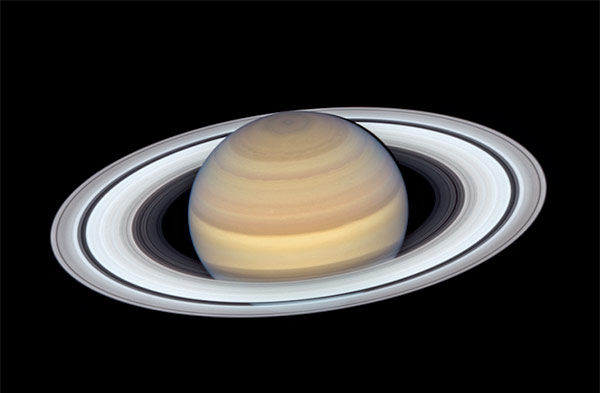
Paradigm of Saturn from the Hubble Infinite Telescope. NASA, ESA, A. Simon, M.H. Wong and the OPAL Team.
Above: I photo the planet Saturn using an xi″ telescope in my backyard.
Uranus
Uranus is the seventh planet from the Sun and like Venus, rotates in the contrary direction as the other planets. Uranus is also the merely planet to rotate on a sideways centrality, meaning it rotates on its side with both poles facing east and west.
Like the other giant planets, Uranus also has 13 faint rings, although the outer rings are more brightly colored and easier to meet.

Uranus' tilted centrality. Space.com (Epitome credit: NASA and Erich Karkoschka, U. of Arizona)
Uranus' atmosphere contains gases like to Jupiter and Saturn in addition to h2o, ammonia, and methane. The unique sideways tilt means that for well-nigh 84 Earth years the Sun shines direct over each pole and the opposite half of the planet experiences long, nighttime winters. Information technology is the coldest atmosphere in the solar system with a minimum temperature of 49 K (−224 °C; −371 °F).
Voyager 2 remains the but investigation of Uranus, studying the structure and composition of the atmosphere, moons, and rings while also making additional discoveries. Voyager made its closest approach to the top of the clouds in 1986, earlier continuing to Neptune.
In 2009, an extension of the Cassini spacecraft mission to Uranus was evaluated but was rejected to move forrard with destroying it in Saturn's atmosphere. The extension would take taken Cassini 20 years to get to Uranus from Saturn.
- Diameter: 31,763 miles (51,120 km)
- Distance from Sun: 19.ii AU
- Twenty-four hour period: 18 World hours
- Orbit: 84 Earth years
- Natural Satellites: 27
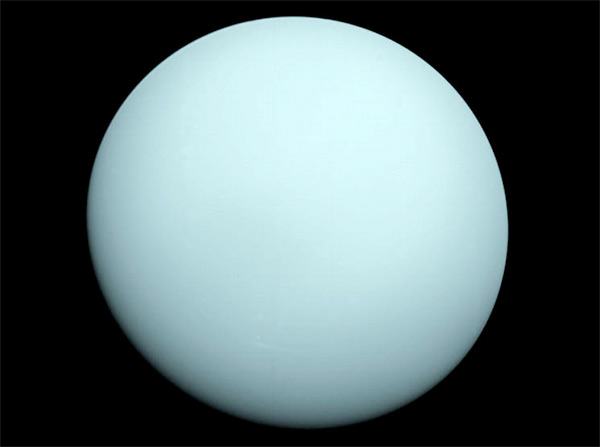
Image of Uranus taken by the spacecraft Voyager 2. NASA/JPL-Caltech.
Neptune
Neptune is the 8th and farthest planet in our solar arrangement. Information technology is the fourth-largest planet and is similar to Uranus consisting of gases, ices, and has a series of moons and faint rings. Neptune was also the only planet whose presence was predicted using mathematics before it was observed visually through a telescope. This prediction was based largely on the changes in the orbit of Uranus.
Neptune has active and visible conditions patterns driven by the strongest and fastest winds of any other planet in the solar system, reaching up to 1,500 mph (2,400 km/h). Neptune's outer atmosphere is one of the coldest places in the solar system.
Voyager 2 is the only spacecraft to have visited Neptune, with a flyby in 1989. The mission confirmed the faint ring arrangement that was discovered a few years earlier. Since the Voyager mission, additional observations proceed to exist fabricated from ground-based telescopes.
- Diameter: thirty,775 miles (49,530 km)
- Distance from Sunday: 30.1 AU
- Day: 19 World hours
- Orbit: 165 Earth years
- Natural Satellites: 14

Image of Neptune was taken by Voyager two. NASA/JPL-Caltech.
Dwarf Planets in Social club from the Sunday
Beyond Neptune is the 'trans-Neptunian region', which is where Pluto and several other dwarf planets are found. To appointment, this region is largely unexplored.
As mentioned in a higher place, a dwarf planet is in direct orbit of the Sun and has enough gravity to pull its mass into a round shape.
However, dwarf planets do not have sufficient gravity to attract or push abroad smaller bodies in society to articulate their orbit and therefore, do not fit the definition of a planet (according to the IAU).
The term dwarf planet, coined by Stern, was adopted by the IAU in 2006 as a category of sub-planetary objects.
Related Video: What is a Dwarf Planet?
Ceres
Ceres is the smallest of the five dwarf planets but is the largest object found in the asteroid belt between Mars and Jupiter. It is also the closest dwarf planet to the sun and is the only dwarf planet inside the orbit of Neptune and not in the Kuiper belt.
It was orbited by the Dawn spacecraft in 2015 just scientists are interested in exploring Ceres for possible signs of life due to the presence of h2o.
Bore: 940 km (584 mi)
Distance from Sun: 2.eight AU
Day: 9 Earth hours
Orbit: four.6 Earth years
Natural Satellites: None
Pluto
Pluto is the ninth largest object orbiting the Lord's day and was known every bit the ninth planet until 2006 when the definition of a planet was changed, and it was reclassified as a dwarf planet.
Pluto is located in the Kuiper belt and has a dissimilar orbit when compared to the other planets in that it is both elliptical and tilted. The dwarf planet is fabricated of ice and rock and is the largest trans-Neptunian object by volume and rotates similar to Venus and Neptune (spinning eastward to due west). New Horizons remains the first and merely spacecraft to wing by Pluto (2015). This historic voyage took nearly ten years and revealed some interesting and unexpected findings.
Diameter: 2376.six km (i,476 mi)
Distance from Sunday: 39 AU (can range from 30-49 AU)
Day: 153 Earth hours
Orbit: 248 Earth years
Natural Satellites: 5 (Charon, Styx, Cypher, Kerberos, and Hydra)

Enhanced image of Pluto, taken by New Horizons spacecraft. NASA/JHUAPL/SwRI.
Haumea
Haumea is effectually the same size as Pluto and is located in the Kuiper belt. It is 1 of the fastest rotating big objects in the solar system which causes its elongated shape.
Haumea resides in the Kuiper belt and is roughly the same size every bit Pluto. It is ane of the fastest rotating big objects in our solar system. Its fast spin distorts Haumea'southward shape, making this dwarf planet wait like a football. It is besides the only Trans-Neptunian object to have a band organisation.
Bore: 1,632 km (1,014 mi)
Distance from Dominicus: 43 AU
24-hour interval: 4 Earth hours
Orbit: 285 World years
Natural Satellites: 2 (Hiʻiaka and Namaka.)
Makemake
The discovery of Makemake (and Eris) was function of the decision to alter the definition of a planet. There are many aspects of this dwarf planet that remain unknown (structure, surface and atmosphere), simply the surface does appear to be like in color to Pluto.
Like the other dwarf planets, Makemake is located in the Kuiper belt.
Diameter: ane,430 km (888 mil)
Altitude from Sunday: 45.8 AU
Day: 22.5 hours
Orbit: 305 World years
Natural Satellites: 1 conditional moon
Eris
Eris is the ninth-largest known object orbiting the Lord's day, the furthest from the Lord's day, and the largest object to have not been visited past a spacecraft.
Eris, which is larger than Pluto, was thought to be the tenth planet after its discovery until the IAU revisited their definition of a planet removing Pluto equally a planet and classifying both Pluto and Eris every bit dwarf planets.
Diameter: two,326 km (1,445 mi)
Distance from Lord's day: 96.3 AU
Day: 25.9 hours
Orbit: 557 World years
Natural Satellites: one (Dysnomia)
Our Galaxy Facts
- Our solar system is located in the Orion Arm of the Galaxy milky way's spiral arm
- The Milky Way milky way is approximately 100,000 lite-years in diameter
- Information technology takes our solar organisation approximately 230 meg years to complete one orbit around the rotational middle of the Milky Way
- There are hundreds of billions of stars in the Galaxy galaxy, and well-nigh of those stars accept their ain planets, known as exoplanets
Related Posts:
- How to Photo Planets (With Whatever Camera)
- How to Photograph the Moon
Source: https://astrobackyard.com/planets-in-order/

Post a Comment for "what is the order of planets, from closest to the sun to furthest from the sun?"