How Long Does It Take for a Baby Kangaroo to Reach Adulthood
What is a Marsupial?
A marsupial is defined by Britannica equally "a mammalian group characterized by premature nascence and connected development of the newborn while attached to the nipples on the female parent'due south lower belly." There are more than 250 marsupial species throughout the world, including kangaroos, koalas, and opossums. Kangaroos, wallaroos, wallabies, tree kangaroos, pademelons, quokkas, bettongs, and pottoroos are marsupials belonging to the family unit Macropodidae, too known as Macropods. According to wallabyranch.org, "the pregnant of the word Macropod is a Greek derivation of 'Large Foot.'" There are over 50 unique varieties of Macropodidae species, all of which reside in Australia and New Zealand.
How are Joeys Born?
Like all mammals, the eggs of a female person kangaroo are fertilized by a male kangaroo through an opening called the cloaca. Similar to birds, the cloaca of a female serves multiple purposes, including mating, birth, and the excretion of waste material. Unlike most other mammals, the unmarried act of fertilization can create two individual embryos.
How is this possible? This diagram from Discover Magazine illustrates the unique makeup of the kangaroo'due south reproductive system:
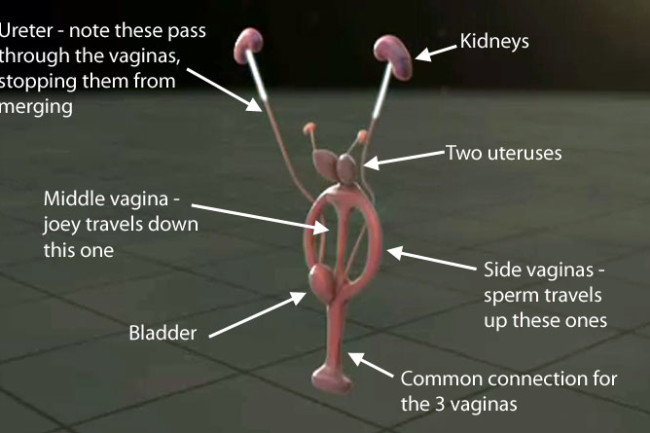
From this epitome, y'all can run into that the female kangaroo non only has ii vaginas, but she as well has two uteri! The male kangaroo, with his similarly unique makeup, is physically capable of accessing both vaginas simultaneously and fertilizing eggs in both uteri, as well.
Although kangaroos are mammals, their resemblance to birds does non stop at the cloaca. Infant kangaroos, called joeys, are not grown within a placenta. In fact, the gestational menses - or the length of the pregnancy - of a kangaroo is only about 28 days. During this fourth dimension, the embryos are furnished with coats and "shells" to attend and protect them. The joey is born in one case he eats his yolk (much like a hatchling). He must be small enough to travel through the center vagina (run across above) into his mother's pouch – at this time, he is roughly the size of a jellybean!
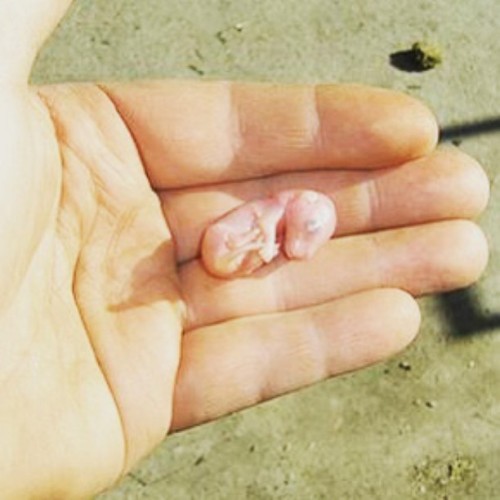
At nascence, a baby kangaroo is merely about 1 inch in length.
Embryonic Diapause
So, why does the female person kangaroo accept multiple uteri if only a single joey is born at a time? The reason for this is a phrase known as "embryonic diapause," an evolutionary accomplishment unique to many marsupials, including the cerise kangaroo, that allows the female kangaroo's torso to halt the progression of development in an embryo at an early stage, when the embryo is fabricated up of only seventy-100 cells, and is only nearly a quarter of a millimeter in diameter. This allows a single embryo to develop, enter the pouch, and reach near-maturation before the second embryo can progress.
The reason for this is multifaceted; should the initial joey neglect to reach his mother'southward nipple subsequently nascency, the female kangaroo's torso volition send a progesterone signal to her other fertilized egg to go along its production. Once a unmarried baby exits a uterus, the female person can get pregnant once again, meaning that female kangaroos can remain perpetually pregnant one time they are of breeding age. If times are tough and at that place is famine, an excess of predators, or other outside stressors on the female, her torso can transport signals to her reproductive organization to terminate the development of her embryos until she is prepared to intendance for an infant. This embryonic diapause can concluding for days, weeks, or even months!
At Babby Farms, it is not uncommon for significant kangaroos to halt the growth of embryos until warmer weather is on the horizon. It is rare for a female kangaroo to requite birth during the months of October through February, although it is non unheard of. During cold Idaho wintertime months, Babby kangaroos, wallaroos, and wallabies are supplied with as much heat as possible, but it is oftentimes non plenty for a mother to feel safe to take intendance of a infant also late into the fall and winter months.
What Happens After the Joey is Born?
Around the time of his nativity, the joey'south mother carefully licks a thick trail of saliva from her cloaca, up through her pouch, to one of her four available nipples. This arduous journey can be done only past the joey alone. His artillery are currently one of the most adult features on his pinky-mouse-like body, and he will clamber his style through his mother's dense hair until he tin can find the nipple and latch on. Once in that location, the mother kangaroo'due south nipple inflates itself, filling her baby's mouth and holding him in identify for several months, until his jaw develops and allows him to unlatch himself and begin suckling of his ain accord. Until then, the mother kangaroo'southward body sends a constant stream of "watery, high poly peptide and simple carb, amnesty-rich milk."
The milk produced by a mother kangaroo is incredible in that her body can determine exactly which type of milk is needed for every growth stage of a joey. For newly born infants, the milk is more like the colostrum plant in mammals like humans and llamas. As the joey ages, his milk composition changes to reflect his growth needs. Echidnawalkabout.com.au continues to say that "older pouch joeys go loftier carb, high protein and some fat [and] big joeys at human foot get massive fatty and poly peptide and low carbs."
Amazingly, this exceptional milk product can apply to multiple joeys at once! While both embryos are not born simultaneously, it is highly likely that the second joey will be born and enter his mother's pouch before his sibling has fully weaned from their mother. Information technology takes approximately six to 9 months for a joey to reach a level of growth big enough for him to leave his mother'due south pouch on his own. Although it is not uncommon for a joey to suckle at the teat until nearly two years of age, once he has fully exited the pouch, he is old plenty to exist pulled from his mother to be bottle fed by humans, and he is developed enough for the female parent kangaroo to feel safe giving nativity to infant number two. And because each joey has his own nipple, the mother kangaroo provides each of her babies with the different types of milk required past both.
Babby's Newest Joey
This yr, nosotros are welcoming the newest addition to the Babby roo family: Kanga! Kanga is Robin's and Kracken's latest offspring. She has only recently been pulled from her mother'due south pouch afterward approximately nine months of growth following her nativity. We believe that Robin already has another infant inside her pouch or is prepare for another baby to enter.
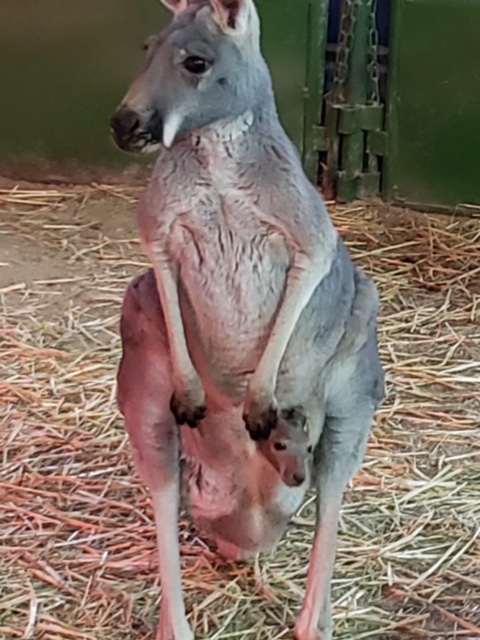
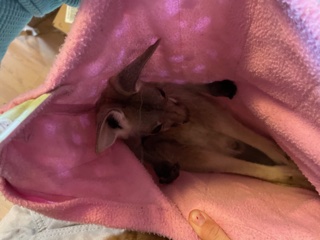
Nosotros are and then excited to get to know Kanga, and we know you will beloved meeting her once nosotros open in May 2021! Congratulations, Robin!
Source: https://babbyfarms.net/blog/the-kangaroo-birthing-cycle/

Post a Comment for "How Long Does It Take for a Baby Kangaroo to Reach Adulthood"